
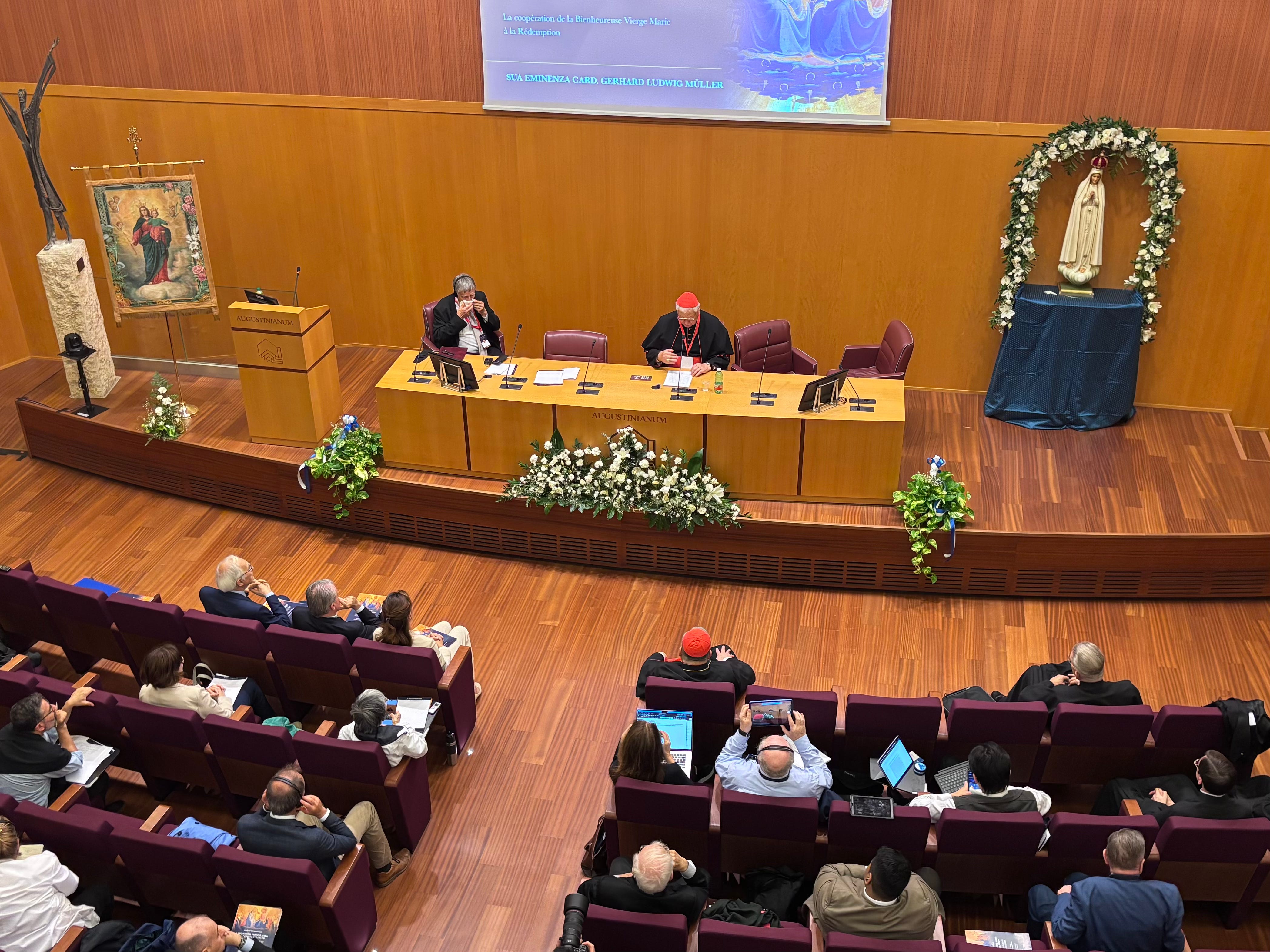
The title “Co-Redemptrix” for the Blessed Virgin Mary is a legitimate expression of Catholic faith, not a misleading exaggeration or a challenge to Christ’s unique place as sole Redeemer and Mediator, Cardinal Gerhard Müller has said.
Speaking at the Oct. 7-8 international Rome conference De Maria numquam satis (“Of Mary one can never say enough”), the prefect emeritus of the Congregation for the Doctrine of the Faith said the title recognises Mary’s singular, subordinate cooperation in salvation, willed “in the freedom wrought by grace.”
“God made the fulfilment of his saving will in the Incarnation, the Cross and the Resurrection of his Son contingent upon the free consent of a single woman, thus entrusting the salvation of all humanity to her virginal and maternal heart,” Cardinal Müller said. “Had she refused her ‘Fiat’, we would all have remained lost for ever.”
God willed not merely to use Mary as a passive instrument but to seek the free consent of a person whom he had preserved from original sin and prepared by grace, he said. Her co-operation was therefore a constituent part of the Incarnation and inseparably connected to Christ’s redemptive work.
“Christ, in his human nature born of Mary — which is, however, hypostatically united to his divinity and thus makes Mary the Mother of God — is the Redeemer and the Mediator between God and humankind,” he explained. “And for this reason, in this sense, Mary too, through her constitutive cooperation in the Incarnation, is indissolubly and intimately linked to the work of redemption.”
The German cardinal rejected the argument that the title should be abandoned to avoid Protestant objections, maintaining that such concerns reflect a theology that does not adequately recognize humanity’s free co-operation with grace.
He stressed that the title “Co-Redemptrix” must be understood analogically, saying that Christ alone redeems humanity in the primary and perfect sense, while Mary’s role is entirely dependent on and derived from his grace.
Nor, he argued, does the title’s later emergence as a theological formulation undermine the truth it expresses, since the Church often gives precise language to realities it has long believed.
As the new Eve, whose obedient faith answers Eve’s disobedience, he said Mary is both the model of the redeemed human person and an exemplar for every baptised Christian called to cooperate with Christ’s salvation.
Cardinal Müller’s remarks come almost a year after the Vatican published Mater Populi Fidelis, a contentious 20-page doctrinal note stating that using the title "Co-Redemptrix" for the Blessed Virgin Mary is “always inappropriate” (or “inopportune”) in official Church language and the liturgy. The document argued that it “risks obscuring Christ’s unique salvific mediation and can therefore create confusion.”
Below is an official English translation of Cardinal Müller’s address, titled “The Blessed Virgin Mary’s Cooperation in Redemption,” published with his kind permission.
The Blessed Virgin Mary’s Cooperation in Redemption
Gerhard Cardinal Müller, Rome
1. The Fundamental Difference between the Catholic and Protestant Concept of Divine Grace and Human Cooperation
One of the greatest theologians of the nineteenth century and a leading figure of the Catholic Tübingen School was Johann Adam Möhler (1796–1838). In his principal work, the Symbolik (1832), he traced the numerous doctrinal differences between Catholics and Protestants back to Christian anthropology. Reference is made to the doctrine of the natural and supernatural image of God; to original sin, which either totally corrupts man’s nature or only wounds it; and to the justification of the sinner through the grace of Christ, the Redeemer (Symbolik, Introduction, §18). The unity of Western Christendom was shattered over the question of the subjective justification of the sinner and its relation to the objective work of redemption accomplished by Jesus Christ. The great question is this: did Adam’s sin not cause, besides the loss of supernatural grace for the whole human race, the total corruption of human nature, created in the image and likeness of God?
To the first part of the question, Catholics and Protestants answer in agreement: yes. In Adam we lost the supernatural grace that made us inwardly like God in spirit and will, and we can regain it only in the grace of Christ, the one Savior of the world. To the second part of the question, Protestants answer, according to their confessional texts, that nothing good and pleasing to God has remained in human nature. In his totally corrupted nature, the sinner would be unable even to observe the commandments of the natural moral law (Rom 2:15), or to recognize the existence of God, at least by reason, to thank him and to love him (Rom 1:20). Because of Adam’s sin, our will would be wholly evil and would hate God. And according to Protestant doctrine, not even redeeming grace is able to restore, heal, and elevate the natural image of God in the creature, even if, based on the divine-human unity of Christ, a nuptial union between nature and grace is realized in man. According to the Protestants’ claims, I am justified in faith solely by trusting in Christ. Christ does not, so to speak, pull me out of the lions’ den, where sin, the devil, and death threaten me with mortal danger; rather, He simply drives away, one by one, the lions that attack me. As long as I live on earth, I am in constant struggle against my nature, which is opposed to God, and I obtain certainty only by trusting constantly, in the act of faith, in Christ alone, that he may keep me far from sin, the devil, and death (simul iustus et peccator).
The Catholic, by contrast, believes that the grace of redemption and justification not only brings about supernatural divinization but also restores man’s nature, with its spiritual and moral faculties, to their original goodness, thereby making it possible to love of God above all things and one’s neighbor as oneself. The inclination to sin, which is opposed to God and to the good — that is, concupiscence — is no longer in itself a sin, but only the residual weakness of a nature that has been fully and completely healed. One who is justified does not sin at all, especially when doing good (DH 1481). One who is baptized sins only, as the Catholic faith affirms, when he freely consents to temptation. Indeed, temptation is in no way a sin in the man who has been justified and regenerated in Christ. The propensity to sin has been left to us so that we may fight against it with the help of grace, and so that, through prayer, fasting, spiritual exercises, and works of charity, we may grow in love of God and neighbor, build up the Kingdom of God, and thus, by reason of our merits in doing good, in accordance with God’s universal salvific will, be rewarded with eternal life.
And it is precisely here that the truth of the Catholic faith is decided, and its distinctive character is revealed — a truth and a character that we must recognize, defend, and proclaim. Between God and man there exists no relationship of rivalry. Irenaeus of Lyons already affirmed this against the Gnostics of his own time and of all times: God neither gains nor loses anything when he makes personal creatures share in His infinite Being, His Spirit, and His inexhaustible goodness. God’s grace does not become greater the less we think of man. His Majesty does not crush us into the dust. On the contrary: the Son, who is consubstantial with the Father, assumes our lowliness and becomes like us men even unto death on the cross, in order to exalt us in His own person to the glory of God the Father. His perfection is manifested in the fact that he creates us without us and redeems us from original sin and from personal sins by pure grace.
2. The Catholic Concept of Collaboration with Grace
God does not exclude us from the work of redemption but includes us, allowing us to participate and collaborate in the work of redemption and in the perfecting of humanity in the communion of the Father, the Son, and the Spirit. Man’s cooperation with God therefore constitutes the highest dignity that God can communicate to man, since nature, created and blessed by God, is fulfilled in the spiritual acts of the knowledge of God and is perfected in moral action in free causality. Thomas Aquinas synthesizes this concept. He distinguishes the level on which God, by His nature, acts alone from the manner in which, on the plane of creation, He confers upon man the grace of cooperation, so that men too may be co-causes of the redemption and justification of sinners, serving as secondary causes and as intermediaries of the first cause. Citing 1 Cor 3:9, “We are God’s fellow workers,” the Angelic doctor affirms: “This is not due to any deficiency in divine power, but because He makes use of intermediate causes, so that the beauty of order may be preserved in things, and so that He may also communicate to creatures the dignity of causality — Neque hoc est propter defectum divinae virtutis: sed quia utitur causis mediis, ut ordinis pulchritudo servetur in rebus, et ut etiam creaturis dignitatem causalitatis communicet” (S.th. I, q. 23, a. 8, ad 2).
We must understand that the creature’s cooperation in God’s plan of salvation is the summit of our human dignity. And it is here that the fundamental difference between the Catholic faith and Protestantism lies.
3. Mariology as the Criterion of Catholic Orthodoxy
For this very reason, Mariology is the culmination of Catholic anthropology and the criterion of Catholic orthodoxy, since the entire work of redemption depends on the fact that God has communicated to Mary the dignitas causalitatis in the accomplishment of his universal salvific will. The act of the Incarnation is the exclusive work of God, for the eternal Son of the Father has assumed human nature from Mary and makes it subsist in his divine person. Indeed, the human nature of the Mother of the God-Man is not a philosophical abstraction, nor a mere organ of a purely biological generation, nor even a passive instrument, but the spiritual nature of a free person. And for this reason, her Fiat is not merely the obedient execution of a superior’s command, as is the case in the military sphere. Rather, God reveals the greatness of His grace in a love that does not overpower but brings about salvation, subordinating itself to the free consent, the consensus, of the creature. God made the accomplishment of His salvific will in the Incarnation, the Cross, and the Resurrection of His Son conditional upon the free consent of a single woman, entrusting to her, in her virginal and maternal heart, the salvation of all humanity. Had she withheld her Fiat, we would all have remained lost forever. But God did not gamble; rather, he chose Mary from eternity so that she might become the Mother of His Son. And for this reason, from the very first instant of her conception, she was also preserved from original sin in view of the redemption of the world through her Son. For this reason, her free yes was not an arbitrary choice between two equivalent possibilities, but the fulfillment of her most pure love, which unites her in a spousal covenant with the Holy Spirit, as His bride.
At the angel’s announcement that she would become the mother of the Son of God, who would be conceived in her womb, carried within it, and born from it, she responded in the strength of prevenient grace and of her freedom from Adam’s guilt: “Behold, I am the handmaid of the Lord; be it done to me according to your word” (Lk 1:38). Mary declares her readiness, in the freedom wrought by grace, to place herself at the service of God’s universal salvific will and thus to collaborate in its historical realization, even to the cross and the resurrection of Christ. And the same Holy Spirit who brought about the Incarnation of the Word in her body and in her will, and who, in His eschatological outpouring upon the disciples of Jesus, makes Mary the Virgin who receives every grace and the Mother of believers. For this reason, Mary is, in a unique way, intrinsically and essentially bound to the saving work of Christ. Through her preservation from original sin in view of the merits of the Mediator between God and men, who from her womb and from her free yesassumed our human nature, Mary represents in her person, and in an archetypal way for all redeemed humanity, the new unity of grace and nature. And grace does not remain alien to nature but divinizes it and shows us the goodness and the glory of the New Man in Christ. Christ, in His human nature born of Mary — which, however, is hypostatically united to His divinity and therefore makes Mary the Mother of God — is the Redeemer and Mediator between God and men. And for this reason, in this sense, Mary too, through her constitutive collaboration in the Incarnation, is indissolubly and intimately bound to the work of redemption. If Mary, with her Fiat mihi secundum verbum tuum, collaborated in a constitutive way in the Incarnation, this also includes — on behalf of all humanity — her collaboration in redemption through the cross of her Son, beside whom she stood, and where her soul was pierced by a sword. For the body that hung upon the cross, and through which Christ offered himself to the Father for the salvation of the world, is the same body that was born of her for the salvation of the world.
4. The Eve–Mary Typology
Messianic salvation begins with Christ and with Mary’s faith and readiness to allow the incarnation of God to take place in her womb. This spontaneously prompts one to contrast, in line with the Pauline Adam–Christ typology, Eve’s disobedience (= voluntary lack of faith) with Mary’s obedience and faith (Lk 1:38; Gen 3; Rom 5:19). Eve, by her disobedience and lack of faith, became the cause of death, whereas Mary became the cause of life. Mary is, in a true sense, the “mother of the living” (Gen 3:20), for just as death came through both sexes, so life had to come through Christ, the man, and through Mary, the woman. Mary stands at the beginning of the history of the faith of the new humanity, that is, of the Church of the new covenant, reborn in faith. By her faith she is, as a virgin, the type of the Church that receives salvation from God and, at the same time, the typological epitome of the essence of the Church, which, by her preaching and saving ministry, continually gives birth, by virtue of faith and baptism, to new members of the body of Christ that is the Church. From the standpoint of a doctrine of redemption worked out in the light of the Incarnation, Mary appears as the companion and helper of Christ (socia Christi) and is consequently, toward the Church and men, the one who intercedes for them and helps them (adiuvatrix).
Mary’s cooperation does not, however, refer to the fact that she supports the work of Christ, the progenitor of the new humanity. Rather, she takes her place with the Church that receives salvation, and cooperates, by the grace she has been given and by her own example, so that the Church and her individual members may let themselves be united, in faith and in love, to Christ their Head, in accord with the relationship that subsists between bridegroom and bride, in which the personal relationship of Christ with the Church and of the Church with Christ is expressed (cf. Eph 5:23).
The theological category of Eve’s disobedience, typically contrasted with Mary’s obedience and faith, already attested to by Justin Martyr and Tertullian, finds a convincing expression in Irenaeus of Lyons:
“That the Lord then was manifestly coming to His own things, and was sustaining them by means of that creation which is supported by Himself, and was making a recapitulation of that disobedience which had occurred in connection with a tree, through the obedience which was [exhibited by Himself when He hung] upon a tree, [the effects] also of that deception being done away with, by which that virgin Eve, who was already espoused to a man, was unhappily misled — was happily announced, through means of the truth [spoken] by the angel to the Virgin Mary, who was [also espoused] to a man. For just as the former was led astray by the word of an angel, so that she fled from God when she had transgressed His word; so did the latter, by an angelic communication, receive the glad tidings that she should sustain (portaret) God, being obedient to His word. And if the former did disobey God, yet the latter was persuaded to be obedient to God, in order that the Virgin Mary might become the patroness (advocata) of the virgin Eve. And thus, as the human race fell into bondage to death by means of a virgin, so is it rescued by a virgin; virginal disobedience having been balanced in the opposite scale by virginal obedience. For in the same way the sin of the first created man (protoplasti) receives amendment by the correction of the First-begotten, and the coming of the serpent is conquered by the harmlessness of the dove, those bonds being unloosed by which we had been fast bound to death” (Adv. haer.,Book V, Ch. 19)
It therefore remains true that “Mary, by her obedience, became the cause of salvation for herself and for the whole human race.” By virtue of the historical fact of her obedience to the word of God, who assumed flesh from her for the salvation of all mankind, Mary is also the model and criterion of the man perfectly united to God. She is the one full of grace, the believer par excellence, and therefore the one who is fully redeemed.
5. The Development of Mariological Dogma
Here one also sees that the two fundamental terms “grace–faith,” correlated with each other like two focal points, are the principle of the history of Mariological dogmas. The affirmations of faith concerning Mary that would subsequently and gradually crystallize in the Church’s consciousness of faith do not, therefore, betray merely an isolated interest in the person of Mary. Rather, in the course of the history of faith, the features of the Christian image of man have become visible in the mirror of the fundamental Mariological affirmations. When, therefore, Mary is called “Co-Redemptrix” in Catholic piety and theology, this is neither a misleading attribution nor an enthusiastic exaggeration, but a truth objectively contained in Revelation. This title must not be suppressed in silence on account of its rejection by Protestants, who, on the basis of their doctrine on justification, understand redemption as excluding man’s free cooperation and thus diminish its scope. Rather, it calls for an explanation within the overall context of the divine-human work of redemption accomplished by Christ, the Son of God, and Mary.
Christological titles are also applied to us by analogy. Christ is the consubstantial Son of God, but we also are, by the grace of adoption, sons of God. This designation as sons in no way calls into question the uniqueness of Christ’s divine sonship in the Most Holy Trinity and the Incarnation but expresses precisely its universal effect. Thomas Aquinas cites another example: the soteriological title of Christ as the one mediator between God and men (1 Tim 2:5) belongs to him in a unique way. Yet priests too (bishops and presbyters) can be called mediators between God and men, since they are servants of the High Priest and Mediator of the new covenant and, as representatives of Christ, administer to men the saving sacraments. They do not, however, exercise the ministry of priest and mediator in a “primary and perfect” manner, but only in a “ministerial and preparatory” way (S.th. III, q. 26, a. 1). And every baptized person is called and bound to collaborate, in the spirit of Mary, so that all men may become sharers in the redemption of Christ.
Anyone familiar with the rules of Catholic theology, therefore, cannot find any reason for scandal in the analogical use of Christological and soteriological titles. Likewise, ecumenical dialogue is not a matter of a false irenicism that would compromise the purity of Catholic doctrine, but of a deeper understanding of the original meaning and its correct conceptual and linguistic formulation. Even with regard to the hierarchy of truths, of which the Second Vatican Council’s Decree on Ecumenism speaks, what is at issue is not a mechanical subdivision between more important and less important doctrines, but rather their analogy in relation to the foundation of the Christian faith: namely, God’s will that all men be saved and come to the knowledge of the truth through the one mediator between God and men, the man Christ Jesus, Son of Mary, she who, through the Incarnation and her Fiat, became the Mother of God.
The principle numquam satis de Maria has nothing to do with a Mariological maximalism that would have to be balanced, diplomatically and pedagogically, by a Mariological minimalism. The principle affirms nothing other than the fundamental truth of the Catholic faith against Gnosticism. According to the Catholic faith, man becomes greater in thought and action the more he allows himself to be sustained by grace and led to the heights of God. In Mary, Mother of the Son of God, of Christ’s Church, and of all believers, we recognize, in a typological and exemplary way, what holds true for all: gloria Dei est vivens homo, vita autem hominis visio Dei (Irenaeus of Lyons, Adv. haer. IV, 20, 7).
6. The Revealed Truth in the Title “Mary Co-Redemptrix”
Nor does the objection hold that the title appeared only from the late Middle Ages onward. For the fact that a truth of faith is contained in Revelation must not be confused with its conceptual formulation. From the very beginning, Christianity has believed in the Incarnation of the Son of God, whereas it was only much later that the Magisterium expressed this mystery in the formula of the unity of the divine and human nature in the person of the Son of God, the hypostatic union. Likewise, Mary’s perpetual virginity and divine motherhood, both clearly attested to in the Bible, have their absolute beginning in God’s election, their foundation in her conception without the stain of original sin, and their fulfilment in the assumption of her body and soul into heaven.
Just as all the mysteries of the Christian faith are intimately interconnected within the analogia fidei (analogy of faith) and mutually interpret one another, so too the dogmatic doctrine concerning Mary is not a subjective collection of disparate elements, but an account of her origin within the one mystery of God’s self-communication in Christ, His Son, as the truth and life of every man who, together with the Mother of believers, says: “Behold, I am the servant of the Lord.”
In his Expositio in Salutationem Angelicam (Commentary on the Hail Mary), the Angelic Doctor asks why Mary is blessed among women, and replies: “Mary brought forth the Source of blessing and opened the gate of heaven. It is surely fitting that her name is Mary, which is translated ‘Star of the Sea’, for just as sailors are directed to port by the star of the sea, so Christians are guided to glory by Mary.”
Translation by Diane Montagna
I have to think that the sexual libertines who have infiltrated the Catholic Church hierarchy are offended by the thought that a mere human being can, through God's grace, achieve perfect purity, and are attempting to minimize the Blessed Virgin Mary's role in salvation in consequence.
Her purity convicts them of their sin.
This is extraordinarily beautiful! Bravo to Cardinal Muller and Cardinal Burke! St Padre Pio said that the Blessed Virgin Mary is the sea we must cross in order to reach the heavenly shores of eternity (I paraphrase from his sublime prose). Padre Alessio said that even when he slept St Padre Pio grasped the rosary (his "weapon." ) so fast in his grasp that it could not be removed! Blessed Virgin Mary pray for us! St Pio pray for us!